
India's foreign exchange reserves surged $5.04 billion in the week ending March 28, its biggest weekly rise in four months, as the central bank started to buy dollars regularly in an effort to build up its defences against any potential global turmoil.

American brokerage firm Morgan Stanley on Thursday sharply cut its India FY23 real GDP growth estimate to 7.9 per cent, mainly due to the impact of the Russia-Ukraine conflict on oil prices. Analysts at the brokerage also raised their inflation forecast to 6 per cent - the upper end of the tolerance band for the RBI - and flagged stagflation risks because of the ongoing events. "We believe that the ongoing geopolitical tensions exacerbate external risks and impart a stagflationary impulse to the economy," they said. It can be noted that stagflation involves a stagnancy in output or growth, coupled with high inflation.

India sharpened measures to curb imports of the yellow metal by hiking the import duty and restricting consignment imports, after shipments jumped to more than 300 tonnes in April and May.

The rupee fell to an all-time low of 61.21 on Monday, sparking speculation about potential measures from the Reserve Bank of India, including providing a special window for oil companies to buy dollars.

New investors should gradually build a 5 to 10 per cent allocation to gold.

Buoyed by healthy farm output and narrowing current account deficit, India is the seventh most economically confident country in the world, a study by global research firm Ipsos has said.

With the fiscal deficit target staring at the government, the FY25 Budget has limited expenditure options, points out A K Bhattacharya.

In absolute terms, the fiscal deficit, or gap between expenditure and revenue receipts, stood at over Rs 5.07 lakh crore (Rs 5.07 trillion) at the end of February, according to the data released by Controller General of Accounts on Thursday.

India's current account deficit (CAD) is likely to ease to 4.4 per cent of the GDP in the current fiscal year on lower oil and gold prices, Bank of America Merrill Lynch (BofA-ML)said in a research note.

Overseas investors have pulled out a net Rs 1,14,855.97 crore from the Indian markets in the current year so far, amid heightened geopolitical tensions and inflation concerns. Foreign portfolio investors have sold domestic equities worth Rs 48,261.65 crore so far this month, taking the year-to-date tally this year to a massive Rs 114,855.97 crore, according to depositories data. The exodus of foreign investors was largely owing to inflationary pressures and deepening global macroeconomic conditions following the Russia-Ukraine war, experts said.

India imports a staggering 1,000 tonnes of gold every year, draining out foreign exchange and putting pressure on the fiscal deficit.

As a major contributor to exports, the IT industry has greater responsibility to perform better in view of the huge Current Account Deficit facing India, said N R Narayana Murthy, whose appointment as Infosys Executive Chairman was ratified by shareholders on Saturday.

The deficit stood over Rs 8 trillion in the first seven months of the current financial year. Non-tax revenues, comprising transfers from the RBI and dividends of the public sector units, shored up the Centre's revenues.

India's economy grew 6.1 per cent in the fourth quarter of 2022-23, pushing up the annual growth rate to 7.2 per cent, official data showed on Wednesday.

Finance Minister Nirmala Sitharaman on Thursday announced a Rs 11.11 lakh crore spending on infrastructure and vowed to continue reforms as she resisted resorting to populist measures in Modi government's last Budget before general elections, instead choosing to stay on the path of cutting deficit while bolstering measures for focus groups.

India, along with Southeast Asian countries such as Indonesia, is expected to sustain growth in the medium-term in Asia region, replacing China as the key growth driver, Morgan Stanley and Nomura said in two separate reports released on Monday. While Morgan Stanley projected a 6.2 per cent gross domestic product (GDP) growth forecast for India in FY24, Nomura estimated the Indian economy to grow at 5.9 per cent in 2023. "Even with a slowing China, we expect GDP growth in Asia to sustainably outperform other emerging markets and the US. India and Southeast Asia are set to be the fastest-growing economies this decade.

In absolute terms, revenue receipts stood at Rs 9.07 lakh crore at the end of October. For the entire 2019-20, the revenue receipts have been pegged at Rs 19.62 lakh crore.

The government should not go in for an 'aggressive fiscal consolidation' in the upcoming Budget as global risks have not abated, RBI Monetary Policy Committee (MPC) Member Ashima Goyal said on Wednesday. Goyal further said subsidies are expected to come down as food and energy inflation moderates. WPI inflation in food articles in November was 1.07 per cent against 8.33 per cent in the previous month.

S&P Global Ratings on Thursday said about half of the Indian companies that it rates are getting a boost in their core profitability from rupee depreciation. "Much of our rated India corporate portfolio has sizable US-dollar linked revenue and, therefore, is not exposed to rupee depreciation. "This encompasses entities in the IT, metals, and chemicals sectors. About half of the firms we rate are getting an EBITDA boost from currency weakening," the US-based rating agency said in a report.

Union Minister Nirmala Sitharaman was on Monday critical of RBI Governor Raghuram Rajan's description of Indian economy as the "one-eyed king in the land of the blind", saying better words should have been used.
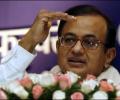
The Economic Survey has acknowledged the measures taken by the UPA government on the macro stabilisation front and the successes achieved in containing the current account deficit and reducing the fiscal deficit.

RBI will take a cue from the Fed policy statement.

While India allows 100 per cent FDI in a large number of the sectors, there is a ceiling on foreign investment in sensitive segments like multi-brand retail, insurance, defence and telecom.
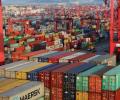
India's exports in January rose 25.28 per cent to $34.50 billion on account of healthy performance by mainly engineering, petroleum and gems and jewellery sectors, even as trade deficit widened to 17.43 billion, according to data released by the commerce ministry on Tuesday. Imports grew by 23.54 per cent to $51.93 billion during the month under review. Trade deficit, difference between imports and exports, stood at $14.50 bn in January 2021.

Exports increased by 10.6 per cent in the first quarter of 2014-15 to $81.7 billion. Imports moderated by 6.5 per cent to $116.4 billion. The CAD, which is the difference between the inflow and outflow of foreign currency, had touched a record high of $ 87.8 billion (4.8 per cent) in 2012-13 fiscal mainly on account of steep increase in gold imports.

The Indian economy recovered from the Covid-induced downturn during 2022 and is poised for further improvement in the coming quarters though downside risks emanating from geopolitical tensions, strengthening dollar and elevated inflation will continue. The positive trajectory in the growth trend and improved fundamentals will help the nation in neutralising the impact of global headwinds which are expected to have a bearing on the country's exports in the months to come. The challenges before the government and the Reserve Bank in the new year would be to arrest inflation, check declining value of rupee against US dollar and promote private investment and growth, with a view to ensure that the country remains one the fastest growing major economies of the world.

The government is considering a 3-rupee to 5-rupee hike in the price of diesel, which accounts for more than 40 percent of fuel use, government officials said last week, as the country looks to cut import costs by nearly $20 billion to trim a record current account deficit.

The government raised import tariff value on gold to $385 per 10 grams.

The Reserve Bank on Wednesday hiked key benchmark policy rate by 25 basis points to 6.5 per cent, citing sticky core inflation. This is the sixth time interest rate has been hiked by the Reserve Bank of India (RBI) since May last year, taking the total quantum of hike to 250 basis points. Announcing the bi-monthly monetary policy, RBI Governor Shaktikanta Das said the Monetary Policy Committee (MPC) by a majority decided to raise the policy repo rate by 25 basis points and keep a 'strong vigil' on inflation outlook.

Given the macro setting, the outlook remains positive for each of the four key parameters - inflation, current account deficit, fiscal deficit and currency stability, says Rahul Bhushkute.

As the reform process is expected to gain further momentum, the Indian rupee will continue to outperform its Asian peers, which are likely to weaken further against the US dollar in 2015, says an HSBC report.
According to SBI Ecowrap, every $10/barrel increase in oil price results in additional import bill of $8 billion.
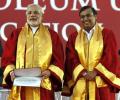
As Narendra Modi sharpened his attack on the government accusing it of failing to curb price rise, Finance Minister P Chidambaram on Friday hit back saying the BJP's prime ministerial candidate will have to "unlearn" a lot before he learns about Indian economy.

In the first such collaboration for India, the country's flagship payments platform, the Unified Payments Interface (UPI), and Singapore's PayNow payment system have launched a real-time cross-border payment linkage system. The linkage, which was launched by Prime Minister (PM) Narendra Modi and Singapore's PM Lee Hsien Loong on Tuesday, was kicked off by a live cross-border transaction between Reserve Bank of India Governor Shaktikanta Das and Monetary Authority of Singapore managing director Ravi Menon, using mobile phones.

A combination of factors, including heavy investments in US Treasury bonds and dollar sales at a healthy profit, facilitated the Indian central bank in transferring a record surplus of Rs 2.11 trillion to the government for 2023-24 (FY24). The RBI's dollar purchases increased in FY24, supported by robust capital inflows endorsing the economy's health.
.jpg)
Subbarao was appointed as the central bank chief on September 5, 2008 for three years and was later given an extension for another two years.

It was 55.3 per cent for the same period last year, and data shows the fiscal deficit for April-May was kept in reasonable check in spite of heavy frontloading of expenditure.

They expressed concern on taxation issues, the high fiscal and current account deficits, and sought removal of capital gains tax.

From the Sensex pack, NTPC, Tata Motors, Titan, Larsen & Toubro, Reliance Industries, IndusInd Bank, Infosys, HDFC Bank and Power Grid were among the major gainers. Wipro and Tech Mahindra were the laggards.

Growth in India is expected to remain strong and stable in 2015
 © 2026 Rediff.com - Advertise with us - Disclaimer - Privacy Policy - Sitemap - Feedback - About us - Terms of use - Grievances